
Home » Navigating Global Power Arteries: Engineering Solutions for Cross-Border Power Transformer Logistics
Navigating Global Power Arteries: Engineering Solutions for Cross-Border Power Transformer Logistics
Power transformers are highly complex, capital-intensive infrastructure assets. Because of their weight and delicate internal clearances, international logistics represents one of the highest risk factors in the entire utility supply chain. A well-known maxim among power engineers states: “Half of a transformer’s operational lifespan is determined during its journey from the factory floor to the substation foundation.”
During cross-border transit from manufacturing hubs to global destination sites, equipment faces punishing conditions: extended maritime voyages (often 30 to 60 days), extreme climatic shifts, and frequent multi-modal handling. Any excessive kinetic impact or moisture ingress can cause catastrophic dielectric breakdown or phase-to-phase short circuits upon energization.
To secure asset integrity, global logistics strategies must draw a sharp line between distribution transformers (small-scale, high-volume units) and large power transformers (main substation units, GSU transformers), executing tailored, engineering-grade logistics solutions for each category.
Distribution & Small-Scale Transformers: Volume Optimization and Environmental Defense
Small-scale transformers (ranging from 50 kVA to 2500 kVA distribution units, including pad-mounted, oil-immersed, and dry-type varieties) are typically shipped in volume inside standard ocean containers (20GP / 40HQ). The logistical challenge centers on maximizing container space utilization without exceeding gross weight limits, while fully isolating equipment from maritime salt spray.
1. The Bottleneck: Spatial Volatility vs. Legal Weight Restrictions
If distribution transformers are simply laid flat across a container floor, a massive amount of vertical headspace is wasted. However, directly stacking these units on top of one another will crush external radiators, corrugated tanks, and high-voltage porcelain bushings. Furthermore, grouping too many units into a single container easily triggers strict international port and highway over-weight penalties—such as the standard 28-ton gross cargo limit.
-
The Solution: Engineered Double-Stack Heavy-Duty Iron Frames
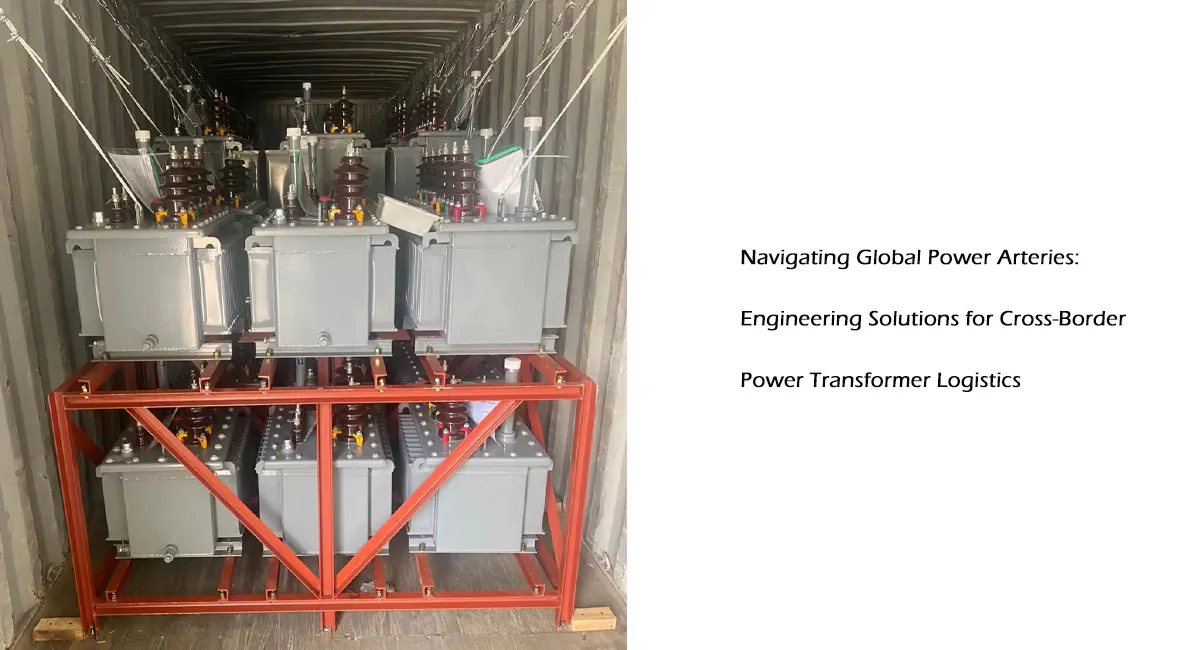
To bypass these constraints, logistics engineers utilize custom-fabricated, high-tensile steel double-stack staging frames rather than traditional wooden crates.
-
The lower tier of transformers is anchored rigidly within the steel base frame, which is engineered to bear the full down-force weight of the upper tier via heavy-duty structural vertical beams.
-
The upper tier of transformers is then bolted and locked onto the top deck of the frame.
-
By calculating the precise fluid-inclusive weight of each transformer, shipments are balanced tightly (typically targeted between 26 and 27.5 tons per container). This doubles spatial payload efficiency while remaining fully compliant with global multi-modal weight thresholds.
-
2. The Bottleneck: Maritime Microclimates and Insulation Degradation
Sustained ocean transit—especially through high-humidity tropical corridors and across the equator—creates a phenomenon known as “container rain.” This continuous condensation cycle causes mold growth on dry-type cast resin surfaces and aggressive salt-spray oxidation on the steel enclosures of oil-filled units.
-
The Solution: Vacuum Sealing, Desiccants, and VCI Barrier Systems
-
Dry-Type Transformers: These units are never shipped exposed. They undergo commercial vacuum heat-shrink encapsulation embedded with calculated volumes of industrial-grade silica gel desiccants. This keeps internal relative humidity low, preventing the cellulose and resin matrices from absorbing ambient moisture and compromising insulation resistance.
-
Oil-Immersed Transformers: Enclosures are coated with multi-layer paint systems compliant with ISO 12944 C5-M (Marine High-Corrosivity) standards. Before containerization, units are wrapped in VCI (Volatile Corrosion Inhibitor) anti-moisture films, and anti-static dielectric silicone grease is applied to all gasket surfaces, pressure relief valves, and terminal bushings.
-
Large Power Transformers: Out-of-Gauge (OOG) Engineering and Structural Stabilization
Large power transformers (LPTs spanning 110 kV to 1000 kV, rated for tens or hundreds of MVA) represent classic Out-of-Gauge (OOG) or heavy-lift project cargo. They cannot fit inside standard containers and must move via flat rack containers, breakbulk vessels, or specialized heavy-lift vessels. The logistical goal shifts toward preventing micro-displacement of internal active parts and managing gas insulation integrity.
1. The Bottleneck: Physical Infrastructure Bottlenecks & Route Surveys
An assembled power transformer can easily exceed 60 to 300 tons in weight and 4 meters in height. Many destination regions (especially developing markets or aging infrastructure zones in Western nations) feature restricted bridge weight ratings, low overhead clearance tunnels, and ports lacking heavy-lift crane capacities.
-
The Solution: Extreme Component Disassembly & Front-End Route Surveys
-
Modular Component Stripping: Prior to leaving the factory, the transformer is stripped down to its bare main tank. High-voltage porcelain/composite bushings, conservator tanks (oil pillows), cooling radiators, Buchholz relays, and low-voltage control cabinets are removed and packed into separate, trackable consolidated containers. The main tank—housing the heavy core-and-coil assembly—travels as a standalone heavy-lift block.
-
Comprehensive Route Surveys: Logistics engineers conduct rigorous physical surveys of the transportation corridor before manufacturing finishes. Every bridge axle-load capacity, overhead power line clearance, and turning radius from the port of discharge to the substation foundation pad is mapped. Specialized multi-axle Self-Propelled Modular Trailers (SPMTs) are deployed to distribute weight evenly across fragile infrastructure.
-
2. The Bottleneck: The Blind Threat of Internal Winding Displacement
During ocean vessel pitching or rail/road transport shunting, transit assets undergo significant deceleration impacts. If a transformer body experiences sudden excessive kinetic energy, the internal copper windings (weighing dozens of tons) can shift by mere centimeters. This structural displacement is completely invisible from the outside but narrows insulation clearances, guaranteeing a high-voltage flashover once energized.
-
The Solution: Rigid Sea-Fastening Welds & Real-Time 3D Impact Recording
-
Rigid Structural Tie-Downs: Once positioned inside a breakbulk vessel hold or on a heavy flat-rack, the transformer base is rigidly secured using high-capacity steel wire rope lashing coupled with direct structural steel welding to the ship’s deck or tank top plates.
-
Continuous 3D Impact Recorder Monitoring: Omnidirectional electronic 3D impact recorders are hard-mounted to symmetrical points on the transformer tank.
⚠️ Global Risk Control Standard: Recorders continuously log acceleration forces ($G$-forces) across the X, Y, and Z axes. Standard industry thresholds mandate that vertical impacts (Z-axis) must not exceed 2.0g, and longitudinal/transverse impacts (X/Y axes) must remain below 3.0g (with strict high-voltage projects limiting thresholds to 1.5g). Upon arrival at the port of entry, data logs are retrieved and audited jointly by the buyer, supplier, and underwriters before the asset is cleared for inland movement.
-
3. The Bottleneck: Main Tank Insulation Protection (Oil vs. Gas Management)
Shipping a massive power transformer fully filled with dielectric mineral oil drastically increases the total transport weight and compromises safety compliance due to international maritime hazardous cargo codes. However, draining the tank entirely introduces atmospheric moisture, which instantly destroys the dielectric properties of the internal cellulose pressboard insulation.
-
The Solution: De-Oiled Vacuum Purging & Positive-Pressure Nitrogen Blanks
-
Gas Displacement: Following successful Factory Acceptance Testing (FAT), the factory drains the insulating oil (often leaving a minimal base layer to submerge low-level leads) and immediately evacuates the tank under a deep vacuum. The void is then backfilled with high-purity nitrogen gas ($\ge$ 99.99%) or ultra-dry air.
-
Continuous Positive-Pressure Maintenance: The transformer tank travels fitted with an automated gas regulation manifold and pressure gauges. Throughout the voyage, the internal tank must maintain a consistent positive pressure baseline of 0.02 MPa to 0.03 MPa. This positive pressure barrier ensures that even during extreme ambient temperature drops, external moisture cannot enter the tank. Auxiliary nitrogen cylinders are securely mounted to the transport frame, allowing logistics personnel to manually top off pressure if minor seal venting occurs along the route.
-
Power Transformer International Logistics Matrix
| Logistics Control Parameter | Distribution & Small Transformer Solution | Large Power Transformer (LPT) Solution |
| Primary Transit Mode | Standard Containerization (20GP / 40HQ) | Flat Rack / Breakbulk Vessel / Heavy-Lift Vessel / SPMT |
| Packaging & Formatting | Double-Stack Heavy-Duty Iron Frames + Vacuum VCI Encapsulation | Main tank shipped bare; delicate components (bushings, radiators) in wood crates |
| Internal Dielectric State | Fully fluid-filled (Oil-Immersed) / Exposed atmospheric state (Dry-Type) | De-oiled and preserved under high-purity nitrogen ($\ge 99.99\%$) gas blank |
| Environmental Safeguards | Volumetric silica-gel desiccant calculation to manage internal container humidity | Automated gas manifold maintaining 0.02 to 0.03 MPa positive pressure with backup cylinders |
| Kinetic Impact Protection | Structural timber dunnage blocks and heavy-duty strapping inside the container | Direct structural deck welding + continuous 3D Impact Recorder acceleration logging ($G$-forces) |
| Critical Delivery Criteria | Zero exterior fluid seepage, clean bushing insulation, verified winding resistance | $G$-force records within safety thresholds (< 2.0g/3.0g), positive gas pressure sustained |
Summary: A Core Closed-Loop Risk Control System for International Transport
Solving the challenge of cross-border transformer transport is, at its core, a process of transforming dynamic uncertainty into static certainty. For smaller transformers, the key lies in using structured steel mounting frames to mitigate mechanical impacts and minimize wasted space within the container; for large main transformers, the focus shifts to using positive-pressure nitrogen filling to block moisture and employing 3D micro-acceleration monitoring to detect and prevent hidden internal damage.
This ensures that high-quality hardware manufactured in China retains its peak, factory-fresh performance even after traversing vast oceans.
Why Trust Instrava?
We select manufacturers from a neutral, impartial standpoint, always with your best interests in mind.
Our very existence depends on helping you source the products that are the perfect fit for your needs.
Based in China, we are able to conduct on-site inspections of production environments and product quality firsthand.
We help you avoid intermediaries posing as factories.
We facilitate smoother after-sales support, eliminating time zone issues and the delays often associated with dealing directly with factories.
Our multilingual team ensures effective communication.
For a trading startup, every interaction with a client is a precious opportunity—a sign that you are willing to place your trust in us and give us the chance to prove ourselves.
In the digital age, while information is easily accessible, misconceptions often cloud the trust between people.
Instrava relies entirely on trust; it is our core philosophy and the foundation of our existence in society. It is the fundamental basis for our long-term growth and our commitment to serving the community.
Please place your trust in us.

Send Inquiry Message
Submit your manufacturing requirements, and our team will get back to you with professional solutions within 24 hours.