
Home » Products » Transmitters » Turbidity Sensor for Accurate Water Quality Monitoring

Turbidity Sensor for Accurate Water Quality Monitoring
Our turbidity sensor is designed for continuous and reliable turbidity measurement in industrial and environmental water applications. Based on the ISO 7027 infrared nephelometric method, it delivers stable, repeatable results while effectively eliminating the influence of sample color.
Key Highlights
-
ISO 7027 compliant infrared scattered light measurement
-
Dual-beam infrared optical detection technology
-
High repeatability and long-term stability
-
RS485 communication for seamless system integration
-
Suitable for standard, customized, and OEM applications
Liquid Analysis Description
Why This Turbidity Sensor
Unlike conventional turbidity sensors that are sensitive to color interference and signal drift, this sensor adopts a dual-beam infrared scattered light photometric design to ensure consistent performance even in complex water conditions.
For procurement teams and system integrators, this means:
-
Reduced calibration frequency
-
Lower maintenance costs over the product lifecycle
-
Stable data output for control and monitoring systems
-
Reliable operation in long-term continuous measurement scenarios
This turbidity sensor is well suited for projects where data reliability and operational stability are critical.
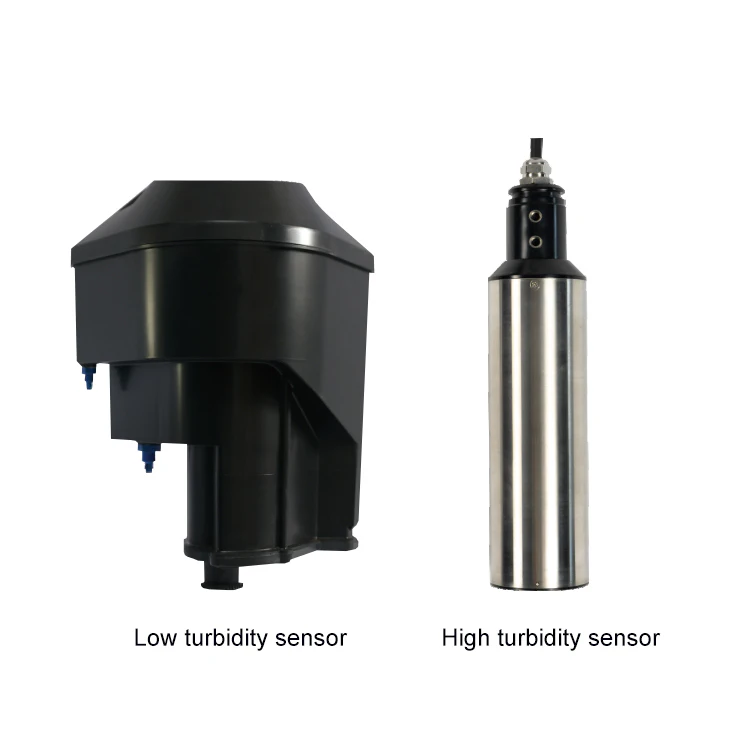

Turbidity Sensor Measurement Technology & Performance
The sensor operates using the ISO 7027 infrared light scattering principle, which minimizes the influence of ambient light and sample color. The dual-beam optical structure enhances measurement consistency and improves resistance to optical contamination.
Performance Advantages
-
Excellent repeatability and measurement stability
-
Built-in self-diagnostic function to ensure data accuracy
-
Suitable for both low and high turbidity measurement ranges
-
Designed for continuous online monitoring
Liquid Analysis Parameter
Measurement Range
-
0.01–100 NTU
-
0.01–4000 NTU
Measurement Accuracy
-
±2% FS or ±0.1 NTU
Temperature Range (Measured Medium)
-
0–45 °C
Flow Velocity
-
Low turbidity sensor: 300–700 ml/min
-
High turbidity sensor: ≤2.5 m/s
Pressure
-
Low turbidity sensor: Atmospheric pressure
-
High turbidity sensor: ≤0.4 MPa
Output Signal
-
RS485
Materials
-
Low turbidity sensor: ABS + 316L
-
High turbidity sensor: 316L + PVC
Ingress Protection
-
IP68 (high turbidity sensor)
Process Connection
-
Inlet: 1/4 NPT
-
Outlet: 1/2 NPT (low turbidity sensor)
Ambient Conditions
-
Temperature: 0–60 °C
-
Relative humidity: <90%
Signal Cable
-
Low turbidity sensor: 3 m (standard, extension not recommended)
-
High turbidity sensor: 10 m (standard), extendable up to 100 m
Instrava OEM/ODM
Tailored Sourcing & Customization: Getting You the Exact Product You Need
As your trusted supplier and sourcing partner, we bridge the gap between your custom requirements and China’s vast manufacturing capabilities.
Finding the right product in a massive supply chain can be challenging. That is where we step in.
As a curated industrial supplier, our core value is simple: we stand in your shoes to help you procure the most optimal products. Whether you are an EPC contractor needing specialized technical compliance, an OEM equipment manufacturer looking for custom branding, or an industrial distributor/trader seeking competitive edge, we customize and tailor products to fit your exact procurement needs.
How We Customize to Fit Your Procurement Needs
For EPC Contractors & Engineers: We custom-configure instruments and devices to match your precise datasheets—tailoring process connections, exotic materials, signal protocols, and managing third-party calibration and testing so you get project-ready solutions.
For OEM Equipment Manufacturers: We provide comprehensive OEM/ODM customization, including custom housing, labeling, branding (private labeling), and tailored technical specifications to seamlessly integrate with your machinery.
For Industrial Distributors & Traders: We offer flexible customization in packaging, product ranges, and technical parameters, helping you differentiate your portfolio and win more local bids.
Why Partner with Us for Custom Sourcing?
One-Stop Engineering Alignment: You don’t have to deal with multiple factories. We translate your technical requirements into precise manufacturer blueprints.
Strict Quality & Compliance Safeguard: We oversee the entire customization and production process in China, ensuring the final customized product meets your local standards and certifications.
Our Ultimate Value: We don’t just sell what’s on the shelf. We find, customize, and deliver the most suitable and cost-effective product for your unique application.

How does this turbidity sensor reduce the influence of water color?
This turbidity sensor is based on the ISO 7027 infrared scattered light method, which minimizes the impact of sample color by using infrared wavelengths instead of visible light. This makes it suitable for complex water conditions where color interference is common.
Is the turbidity sensor suitable for continuous online monitoring?
Yes. The sensor is designed for continuous online measurement and offers stable output, good repeatability, and built-in self-diagnostic functions to ensure reliable long-term operation in industrial and environmental monitoring systems.
What is the difference between low and high turbidity versions?
The low turbidity sensor is optimized for high sensitivity and low flow conditions, while the high turbidity sensor is designed for harsher environments with higher flow velocity and pressure. Each version uses different materials and mechanical structures to match its application range.
Can this turbidity sensor be integrated into existing control systems?
The sensor supports RS485 communication, making it suitable for integration with PLCs, controllers, and upper-level monitoring systems commonly used in water treatment and industrial automation applications.
How is sensor maintenance handled in high-fouling environments?
An optional automatic wiper cleaning function is available to reduce fouling on the optical surface. This feature helps maintain measurement stability and significantly reduces manual maintenance requirements.
Does Instrava support customization or OEM integration for this turbidity sensor?
Instrava provides customization and OEM support, including measurement range selection, material options, cable length, and integration requirements. Engineering support is available to ensure compatibility with specific system designs and applications.
Why Trust Instrava?
We select manufacturers from a neutral, impartial standpoint, always with your best interests in mind.
Our very existence depends on helping you source the products that are the perfect fit for your needs.
Based in China, we are able to conduct on-site inspections of production environments and product quality firsthand.
We help you avoid intermediaries posing as factories.
We facilitate smoother after-sales support, eliminating time zone issues and the delays often associated with dealing directly with factories.
Our multilingual team ensures effective communication.
For a trading startup, every interaction with a client is a precious opportunity—a sign that you are willing to place your trust in us and give us the chance to prove ourselves.
In the digital age, while information is easily accessible, misconceptions often cloud the trust between people.
Instrava relies entirely on trust; it is our core philosophy and the foundation of our existence in society. It is the fundamental basis for our long-term growth and our commitment to serving the community.
Please place your trust in us.