
การกันเสียง: ความลับสู่ชีวิตที่สุขภาพดี

ผู้ให้บริการด้านการจัดหา
Acoustic insulation is an effective way to protect privacy and reduce the intrusion of unwanted external noise. By limiting sound transmission between spaces, it helps create a quieter, more comfortable, and healthier living and working environment.
1. The Impact of Noise on Human Health
1.1 Sleep and Rest Disturbances
Noise interferes with sleep and rest. During the night, when quiet is essential for recovery, traffic noise and crowd noise can disrupt sleep. Intense noise can make it difficult to fall asleep, cause agitation, increase dream frequency, or trigger sudden awakenings. Older adults and people with illnesses may be particularly sensitive to these disturbances.
1.2 Psychological Stress and Reduced Work Efficiency
Noise can cause annoyance, agitation, and irritability, sometimes leading to a loss of composure. It can also contribute to fatigue, impair concentration, and reduce work efficiency, particularly for people performing tasks that require sustained attention or complex decision-making.
In addition, noise can mask warning sounds and danger signals, increasing the risk of workplace accidents in noisy construction zones and industrial facilities.
1.3 Effects on Fetuses and Children
Noise exposure may affect fetal development and children’s health. Research suggests that excessive noise can trigger stress responses in pregnant women and may influence maternal physiological functions, potentially affecting fetal development and birth outcomes.
Fetuses, newborns, and young children are particularly vulnerable because their auditory systems and other physiological functions are still developing. Excessive noise exposure may contribute to hearing impairment and interfere with children’s sleep, attention, learning, and cognitive development. However, the extent of these effects depends on factors such as noise intensity, exposure duration, and individual susceptibility.
1.4 Effects on Women’s Health
Noise exposure may affect women’s health through stress-related physiological responses. Potential effects include sleep disturbances, psychological stress, and changes in reproductive health.
Some studies have also investigated associations between high-intensity occupational or environmental noise exposure during pregnancy and adverse pregnancy outcomes, including hypertensive disorders and low birth weight. These associations depend on exposure conditions and other contributing factors, and the evidence does not establish that noise alone directly causes these outcomes.
2. Analysis of Noise Impact Based on Residential Floor Level
No official table for this; the numbers below come from published per-floor measurements. English version of the full answer:
Finding
Noise does not fall monotonically with height. Measured profiles almost always form a low at the lower floors, a peak in the mid-rise band, then a gradual decline. The peak typically sits between the 5th and 13th floor, and where it lands depends on the road type (at-grade vs. viaduct/stacked corridor), the setback distance and the shielding of the front row of buildings. The chart below uses a published per-floor daytime dataset for a 17-storey residential building, measured at two distances from the road centreline (37 m and 71 m), peaking at the 9th floor (74.2 dB) and the 13th floor (72.4 dB) respectively.
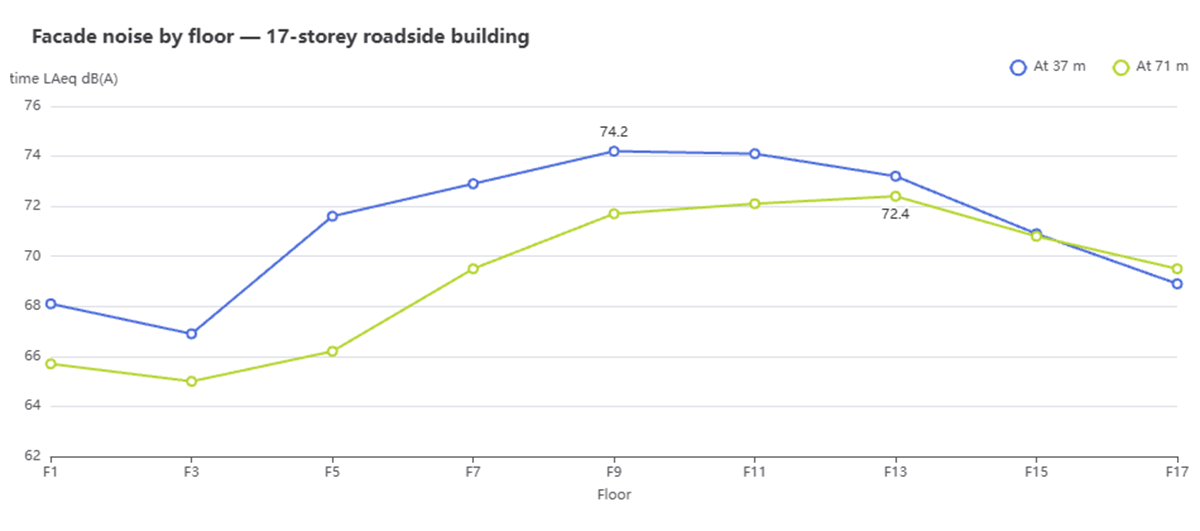
How to read it: (1) the 3rd floor is quieter than the 1st (66.9 vs 68.1) — a sound shadow cast by the viaduct deck and its barrier; (2) floors 9–13 (roughly 27–39 m) form the peak band, where the direct path has cleared the barrier while atmospheric attenuation has not yet taken over; (3) the farther measurement peaks higher (13th instead of 9th floor) and decays more slowly near the top — at the 17th floor the 71 m point (69.5) is marginally above the 37 m point (68.9).
Where the data comes from
| Data / chart | Site and sample | Measured result | Source |
|---|---|---|---|
| The two plotted curves (raw per-floor LAeq) | A stacked viaduct + at-grade corridor (two-level, six lanes each direction) in a Chinese city; 17-storey residence at 37 m and 71 m from the road centreline; odd floors 1–17; daytime multi-period averages | At 37 m: 1F 68.1 → 9F 74.2 → 17F 68.9; at 71 m: 1F 65.7 → 13F 72.4 → 17F 69.5 | “Study on noise control countermeasures for urban sections of expressways” (高速公路通城市路段声环境影响防治对策研究), Noise and Vibration Control (噪声与振动控制), 2021, No. 1, Table 1 |
| Kaifeng high-rise: simulation validated against measurement | 17 storeys, 51 m; 15 m from road centreline; floors 1–9, 11, 13, 15, 17 measured with the instrument 1 m outside the window, 13 runs × 20 min per floor | 1F ≈ 64 dB → 7F (≈22 m) ≈ 72 dB (maximum) → 17F ≈ 66 dB; predicted vs. measured within ±2 dB | Lou Jinxiu & Ma Jianhua, “Simulation of noise vertical distribution of high-rise buildings using Cadna/A” (基于 Cadna/A 的高层建筑环境噪声垂直分布仿真), Noise and Vibration Control, 2014, 34(3): 136-138 |
| Foshan Chancheng high-rise field measurement | High-rise block beside Jihua Road and Shenhua Road; equal-interval per-floor measurement | Peak at the 5th–10th floor | Wei Guohui, “Analysis of vertical distribution law of high-rise building noise in adjacent roads in Chancheng District” (禅城区临近道路高层建筑噪声垂直分布规律分析), Environment and Development (环境与发展), 2019, No. 4 |
| Fuzhou 30-storey field measurement | Hongyan Building beside Wuyi South Road; all 30 floors | Peak at the 9th floor; the author also notes the guideline-recommended model cannot predict vertical distribution accurately and that analogous field measurement is more reliable | Li Jiabing, “Vertical distribution law of urban traffic noise” (城市交通噪声在垂向上分布规律研究), Journal of Fujian Normal University (Natural Science Edition), 2011(1): 105-108 |
| Guangzhou at-grade + viaduct field measurement | 6th, 10th and 14th floors; indoor and outdoor measured simultaneously | Outdoor level first rises then falls with height; outdoor exceeds indoor by ≈15/18/17 dB on those floors, with indoor steady at 55–57 dB | Buildings 2024, 14(8): 2380 |
| Shanghai 14-storey slab block in a shielded, quiet compound | All 14 floors, 3 m floor-to-floor; day and night periods | Lower floors slightly quieter than upper floors; max spread across floors 3 dB (day) and 4.5–5.1 dB (night) | Yang & Kang, Frontiers in Psychology, 2023 |
| Tehran motorway front facade | 27 m (9-storey) tower; 121 validation points at 5–25 m horizontal distance and 3–39 m height | Front facade falls from 76 dBA at ground level to 72 dBA at the top edge; the authors conclude height is not an effective mitigation factor | 3D Analysis and Investigation of Traffic Noise Impact from Hemmat Highway…, SCIRP |
Why the shape looks like this
- Geometric divergence: the theoretical loss is 20 lg(r), but rising one to fifteen floors adds only a few metres of path length — typically 3–6 dB — which is outweighed by the other terms.
- Barrier / viaduct shadow: a barrier attenuates mid and high frequencies but not low ones; once the floor rises above the barrier’s top edge the insertion loss disappears abruptly. That is the step between the dip at the 3rd floor and the peak at the 9th.
- Ground effect and vegetation: ground absorption and tree canopy keep the lower floors 2–4 dB quieter.
- Atmospheric absorption and distant sources: above the peak band, air absorption and distance take over and the level falls; at night, when near traffic thins out, distant arterials and viaducts dominate and the upper floors can actually be louder — which is why night profiles are often flatter than daytime ones.
- The regulatory calculation framework: Annex A of HJ 2.4—2021 specifies exactly the GB/T 17247.1/17247.2 (identical to ISO 9613) engineering method, itemising geometric divergence, atmospheric absorption, ground effect, surface reflection and obstacle screening. This is also the calculation core of Cadna/A and SoundPLAN.
3. Methods of Sound Insulation
Sound propagation requires a medium, such as a solid, liquid, or gas. This provides the physical basis for understanding how sound insulation works. In practice, sound insulation uses the properties and arrangement of materials to reflect, absorb, or dissipate sound energy and reduce the amount of sound transmitted from one space to another.
3.1 Reducing Sound Transmission Through Differences Between Media
When sound travels from air into a solid material, such as a wall, door, or window, the difference in acoustic impedance between the two media causes some sound energy to be reflected at the interface. The remaining energy may cause the solid structure to vibrate and transmit sound to the other side.
Walls with sufficient mass and appropriately designed layered structures can reduce this transmission. However, their performance also depends on resonance, sound frequency, structural connections, and the quality of installation.
3.2 Absorbing and Converting Sound Energy Within Materials
Porous materials, such as mineral wool, rock wool, glass wool, and specialized acoustic absorbers, contain interconnected pores or air passages. When sound waves enter these materials, air movement within the pores produces viscous friction and thermal losses, converting part of the sound energy into a small amount of heat.
These materials are particularly useful for absorbing sound within wall cavities and reducing reverberation when incorporated into suitable acoustic systems. However, porous absorption alone does not necessarily provide high sound insulation between rooms.
4. How Wall Panels Achieve Sound Insulation
แผงผนัง can help reduce sound transmission through four main mechanisms: increasing mass, absorbing sound energy, interrupting vibration transmission, and sealing gaps that allow sound to bypass the wall.
4.1 Increasing Mass: Blocking Sound Transmission
This approach uses panels with higher surface mass, such as multiple layers of gypsum board, cement board, or other high-density composite panels.
When sound waves strike a wall, they cause the wall structure to vibrate. In general, increasing the wall’s surface mass can reduce sound transmission over certain frequency ranges. However, actual performance also depends on the wall assembly, structural connections, resonance, and installation quality.
Applications:
- Gypsum board partition walls
- Composite sound-insulating wall systems
- High-density wall panel assemblies
4.2 Porous Sound Absorption: Dissipating Sound Energy
This method uses materials such as mineral wool, rock wool, glass wool, and specialized porous acoustic absorbers.
When sound waves enter these materials, air moves within their pores. Viscous friction and thermal exchange dissipate part of the sound energy as heat, reducing sound reflections and helping improve the acoustic performance of the overall wall assembly.
Applications:
- Recording studios
- Conference rooms
- Cinemas and home theaters
- Office acoustic wall systems
Important note: Sound-absorbing materials are often installed inside wall cavities or behind acoustic panels. Their primary function is to absorb sound energy; the complete wall structure determines how effectively sound transmission between rooms is reduced.
4.3 Structural Decoupling: Reducing Vibration Transmission
Structural decoupling reduces the direct transmission of vibrations through rigid connections between the two sides of a wall. Common techniques include double-layer wall panels, double-stud framing, and resilient vibration-isolating connectors.
By reducing rigid mechanical connections, these systems limit the transfer of structural vibration from one side of the wall to the other. When combined with cavity insulation and adequate surface mass, they can significantly improve sound insulation.
Applications:
- Bedroom partition walls
- Hotel guest rooms
- Office meeting rooms
- Recording studios and other sound-sensitive spaces
4.4 Sealing Gaps: Preventing Sound Leakage
Even wall panels with excellent sound insulation performance can be undermined by small gaps and unsealed openings. Sound can bypass the wall through panel joints, perimeter gaps, door and window interfaces, and openings for electrical wiring, pipes, or ventilation systems.
Properly sealing these paths helps maintain the acoustic integrity of the complete wall assembly. Doors, windows, and other penetrations should also be selected and installed with appropriate acoustic performance.
Applications:
- Interior partition walls
- Residential wall systems
- Commercial office partitions
- Hotel rooms and other spaces requiring privacy
| Wall Panel Type | Main Acoustic Mechanism | Sound Insulation Performance | ข้อควรพิจารณาหลัก |
|---|---|---|---|
| Gypsum Board | Sound insulation through mass; performance improves with multiple layers and proper wall assembly design | Good when used in a properly designed wall system | Double-layer gypsum board, cavity insulation, and sealed joints can improve performance |
| Rockwool Sandwich Panel | Combines the mass of the panel facings with sound absorption by the mineral wool core | Depends on panel construction, thickness, joints, and installation | Mineral wool absorbs sound within the cavity, but the complete panel system determines overall sound insulation |
| Glass Wool Panel | Porous sound absorption through friction and heat dissipation | Limited as a standalone sound barrier; more effective when integrated into a complete wall assembly | Commonly used inside wall cavities or behind acoustic panels |
| MDF / Wood Panel | Sound insulation primarily through mass; perforated or slotted designs can improve sound absorption | Moderate to limited, depending on thickness, density, and assembly | Perforated panels typically require an acoustic backing layer, such as mineral wool |
| PVC Wall Panel | Limited sound insulation due to its relatively low mass and thin construction | Generally limited when used as a single decorative layer | Primarily used for decoration and moisture resistance rather than soundproofing |
| WPC Wall Panel | Sound insulation depends on panel density, thickness, and installation structure | Generally limited for standalone decorative panels | A thicker panel does not necessarily provide high sound insulation; the complete wall structure matters |
| HPL Decorative Panel | Primarily provides a decorative and protective surface; sound insulation depends on the substrate and wall assembly | Generally limited when used alone | Often installed over a substrate; the substrate and mounting system contribute more to sound insulation |
| Perforated Acoustic Panel | Sound absorption through perforations and an absorptive backing layer | Primarily reduces sound reflections and reverberation rather than blocking sound transmission | Commonly used in offices, conference rooms, auditoriums, and other spaces requiring acoustic control |
Important distinction: Sound insulation reduces sound transmission from one space to another, while sound absorption reduces sound reflections and reverberation within a space. A wall panel designed for sound absorption does not necessarily provide effective sound insulation.
สรุป
Effective acoustic insulation depends on the performance of the entire wall system rather than the แผงผนัง alone. Increasing surface mass, incorporating porous sound-absorbing materials, reducing structural vibration transmission, and sealing gaps can work together to reduce unwanted noise.
When selecting wall panels for residential or commercial projects, it is important to distinguish between sound insulation, which reduces sound transmission between spaces, and sound absorption, which reduces reflections and reverberation within a space.
Improving the quality of healthy living extends beyond what we eat, wear, or how we travel—it also encompasses the environment in which we live.