
เส้นใยไม้ไผ่: วัสดุ คุณสมบัติ การใช้งาน กระบวนการผลิต และการจัดหา
ผู้ให้บริการด้านการจัดหา
1. What Is Bamboo-Wood Fiber?
Bamboo-wood fiber is a composite material commonly used in China’s interior decoration industry. It is generally manufactured by combining bamboo powder, wood powder, polymer resin, calcium carbonate, and various functional additives.
Although the term “bamboo-wood fiber” is widely used in the Chinese wall panel market, it is not a universally standardized material classification. Many products sold under this name belong to the broader category of Wood-Plastic Composites (WPC), particularly PVC-based WPC.
1.1. Bamboo-Wood Fiber vs. WPC
In the context of product development, bamboo-wood fiber wall panels can be understood as a type of decorative product developed using WPC technology, particularly for interior wall applications.
However, the two terms are not interchangeable in every case. WPC is a broader material category that includes different natural fibers and thermoplastic polymers, while bamboo-wood fiber generally refers to a specific group of composite decorative products marketed in China.1
Summary of the Main Differences Between Bamboo-Wood Fiber and WPC
| Comparison | Bamboo-Wood Fiber | Wood-Plastic Composite (WPC) |
|---|---|---|
| Material Definition | A commercial material commonly used for interior decorative products in the Chinese market | A broad category of composite materials made from natural fibers and thermoplastic polymers |
| Raw Materials | Commonly consists of bamboo powder, wood powder, PVC resin, calcium carbonate, and additives | Typically consists of wood powder, wood fibers, bamboo fibers, or other natural fibers combined with PE, PP, or PVC |
| Plant Fiber Sources | Mainly bamboo and wood-based materials, depending on the formulation | Can include wood, bamboo, rice husks, and other natural fibers |
| Plastic Base | Commonly PVC-based | Can be PE-based, PP-based, or PVC-based |
| Manufacturing Process | Commonly produced through mixing, extrusion, surface lamination, and other finishing processes | Manufacturing methods vary depending on the resin system and product type; extrusion and molding are common |
| Typical Product Forms | Integrated wall panels, decorative wall panels, ceiling panels, and interior trim | Decking, fencing, outdoor cladding, wall panels, ceiling panels, and other composite products |
| Main Applications | Primarily interior decoration | Both indoor and outdoor applications |
| Moisture Resistance | Generally offers good moisture resistance, depending on the formulation and product structure | Varies according to the resin type, fiber content, and manufacturing process |
| Water Resistance | Often suitable for interior environments exposed to occasional moisture, but not necessarily waterproof | Depends on the formulation; PE- and PP-based WPC products generally have good moisture resistance |
| Dimensional Stability | Depends on material composition, density, and manufacturing quality | Depends on fiber content, polymer type, and product structure |
| Weather Resistance | Standard interior-grade products are generally not designed for prolonged outdoor exposure | Some formulations are specifically designed for outdoor use and can offer better weather resistance |
| Market Positioning | Commonly marketed as an integrated decorative material in the Chinese interior decoration market | A broader material category covering various interior and exterior composite products |
The actual composition and performance of bamboo-wood fiber panels depend on the manufacturer’s formulation, raw materials, and production processes.
2. Characteristics of Bamboo-Wood Fiber Materials
Bamboo-wood fiber panels offer several characteristics that make them suitable for interior decorative applications. Their actual performance depends on material composition, panel structure, manufacturing quality, and surface treatment.
2.1. Moisture Resistance
Bamboo-wood fiber wall panels, particularly PVC-based products, generally offer good moisture resistance in typical indoor environments. This makes them suitable for spaces that require a degree of moisture protection, such as kitchens and the dry zones of bathrooms.
Bamboo and wood fibers can serve as reinforcing components in polymer composites; however, the fibers’ hygroscopicity, interfacial bonding, and the material mixing ratio can influence the properties of the final product.2
2.2. Water Resistance
PVC-based composites generally have low water absorption compared with many conventional wood-based materials. Surface laminates can further reduce direct moisture contact.
However, water may still enter through panel joints, cut edges, or installation points. Therefore, these products should not automatically be classified as completely waterproof.
2.3. Decorative Versatility
Through processes such as lamination, thermal transfer printing, and embossing, bamboo-wood fiber panels can feature various surface finishes, including wood grain, stone patterns, fabric textures, and solid colors.
These decorative options allow the panels to accommodate different interior design styles and architectural requirements.3
2.4. Lightweight Structure
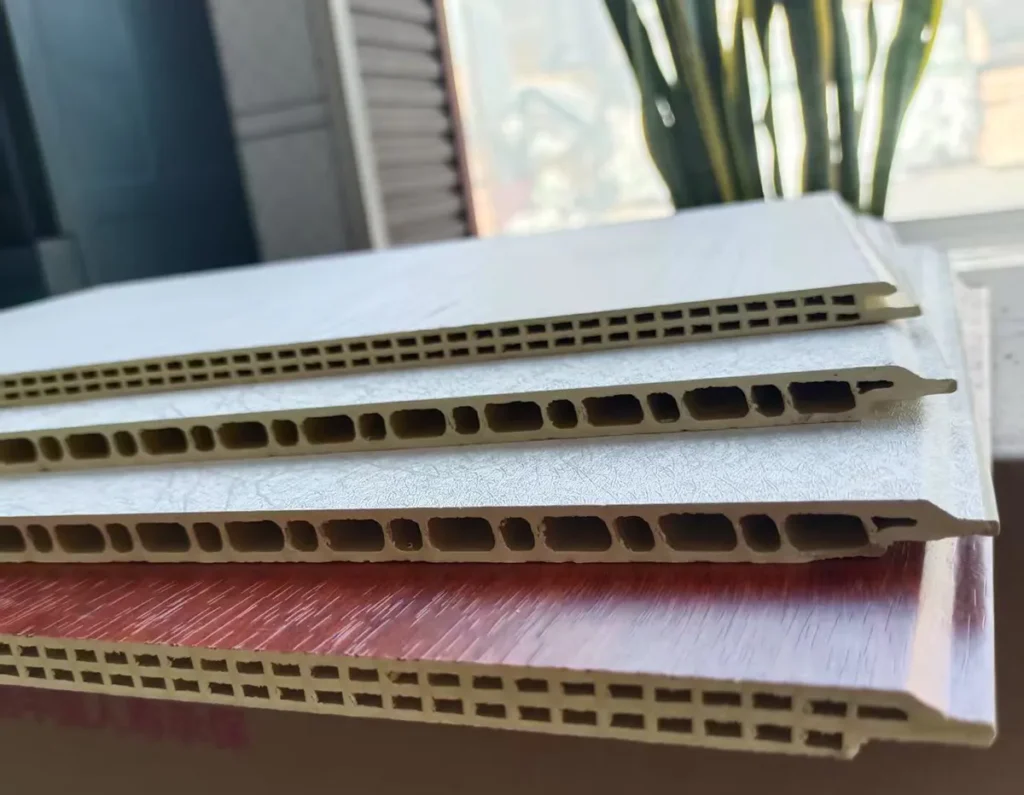
Some products utilize hollow-extruded structures, making them lighter than comparable solid panels. This facilitates transportation, handling, and installation while potentially reducing the load on wall decoration systems.
2.5. Installation Convenience
Bamboo-wood fiber panels commonly use installation methods such as snap-fit joints, interlocking systems, and attachment to supporting frameworks or battens.
Many systems can be installed without traditional wet construction methods involving mortar or cement, helping improve the efficiency of interior renovation projects.
2.6. Easy Maintenance
The surfaces are typically smooth and can be cleaned with a damp cloth. However, resistance to stains, scratches, and chemical cleaning agents depends on the quality of the surface coating or decorative laminate.
2.7. Dimensional Stability
Compared with many natural wood materials, PVC-based composite panels are generally less sensitive to changes in environmental humidity.
However, temperature fluctuations can still cause thermal expansion or contraction. Adequate expansion gaps and appropriate installation methods are therefore important.
2.8. Fire Performance
PVC has inherent flame-retardant characteristics compared with some other common plastics. However, the actual fire performance of bamboo-wood fiber wall panels depends on the complete formulation, including the polymer content, natural fiber content, additives, and product structure.
Fire performance should be verified through relevant testing and classification reports rather than inferred from the presence of PVC.
3. Bamboo-Wood Fiber Products and Applications
Bamboo-wood fiber composites are primarily used in interior architectural decoration, although related composite formulations can also be developed for furniture components and other applications.
3.1. Common Product Types
| ประเภทสินค้า | English Name |
|---|---|
| Type 1 | Integrated Wall Panels |
| Type 2 | Decorative Wall Panels |
| Type 3 | Ceiling Panels |
| Type 4 | Door Panels |
| Type 5 | Furniture Panels |
| Type 6 | Skirting Boards |
| Type 7 | Decorative Mouldings |
3.2. Interior Architectural Decoration
Interior decoration is the primary application of bamboo-wood fiber wall panels.
They are used for wall and ceiling finishes in residential spaces, including living rooms, bedrooms, studies, kitchens, and bathrooms, subject to the product’s intended-use specifications.
In commercial and public projects, decorative composite panels may also be used in offices, hotels, schools, healthcare facilities, sports facilities, shopping malls, restaurants, and leisure spaces.
3.3. Furniture Manufacturing
Bamboo-wood fiber composites and related materials can be used for furniture components such as decorative cabinet panels, door panels, and interior finishing elements.
Their suitability for structural furniture applications depends on mechanical properties, density, screw-holding strength, and other performance requirements.
3.4. Industrial and Specialized Applications
Related polymer-based composite panels are also used in selected specialized applications, including interior linings for buses and railway carriages, cleanroom wall systems, suspended ceilings, advertising signage, and exhibition display boards.
Some WPC formulations are also developed for exterior wall cladding and other outdoor applications. However, standard interior-grade bamboo-wood fiber panels should not be assumed suitable for outdoor exposure without appropriate weather-resistance testing.
4. How Is Bamboo-Wood Fiber Made?
Bamboo-wood fiber wall panels are commonly manufactured through a compounding and extrusion process. Depending on the formulation and production equipment, manufacturers may use different processing routes.
The following describes a typical PVC-based bamboo-wood fiber panel manufacturing process.
4.1. Fiber Pretreatment and Drying
Bamboo or wood raw materials are processed into powder or fine particles through crushing, grinding, and screening.
Some manufacturers may use additional fiber pretreatment methods to improve material compatibility and processing performance.
The resulting powder is dried to reduce moisture content before compounding. Excessive moisture can cause bubbles, voids, and surface defects during extrusion.
The required particle size and moisture content depend on the formulation and production equipment.
4.2. Batching and High-Speed Mixing
According to the product formulation, bamboo powder, wood powder, polymer resin, mineral powder such as calcium carbonate, and functional additives are measured and fed into a mixing system.
Hot and cold mixing stages may be used to distribute the ingredients evenly and improve the consistency of the compound.
4.3. Extrusion Molding
The prepared mixture is fed into a twin-screw or single-screw extruder, depending on the material formulation and manufacturing process.
Inside the extruder, the material undergoes heating, mixing, compounding, and degassing before being pushed through a shaping die to form a continuous panel profile.
Processing temperatures are controlled according to the resin type, formulation, and equipment configuration. PVC-based formulations require particular attention to temperature control to prevent thermal degradation.
There are two common processing routes:
One-Step Extrusion
The mixed raw materials are directly processed through extrusion to form the panel profile. This route can simplify production and reduce processing stages.
Two-Step Extrusion
The raw materials are first compounded into pellets. These pellets are then fed into a second extrusion process to produce the finished panel profile.
The two-step route provides an additional opportunity to control material compounding and consistency, although final product quality still depends on the formulation and process controls.4
4.4. Vacuum Calibration and Haul-Off
After leaving the extrusion die, the hot panel profile enters a vacuum calibration and cooling system.
Vacuum pressure helps maintain the required cross-sectional dimensions while the material cools and solidifies.
A haul-off machine pulls the profile through the production line at a controlled speed to maintain consistent dimensions and surface quality.
4.5. Sanding and Dust Removal
Depending on the surface finishing requirements, the panel may undergo sanding or surface preparation to improve flatness and remove manufacturing imperfections.
Dust is removed before subsequent lamination or coating processes to help ensure proper surface adhesion.
4.6. Profile Grooving and Edge Processing
Tongue-and-groove, V-joint, or other interlocking profiles may be machined or formed along the panel edges.
These profiles allow panels to connect during installation and help create a continuous decorative surface.
4.7. Surface Lamination and Coating
The panel surface can be finished using different decorative technologies, including:
- Hot-melt adhesive lamination.
- Thermal transfer printing.
- UV coating.
- Co-extrusion.
- Embossing and surface texturing.
These processes can create wood grain, stone textures, fabric patterns, and other decorative finishes.
Some products use multilayer structures to improve surface appearance and specific performance characteristics. The actual layer configuration varies by manufacturer.
4.8. Cutting, Inspection, and Packaging
The finished panel profiles are cut to the required lengths and inspected for dimensions, surface defects, and other quality requirements.
After inspection, the products are packaged according to customer specifications and prepared for shipment.
Bamboo-wood fiber wall panels are therefore not simply bamboo pressed into boards. Many products are extruded fiber-filled polymer composite profiles. Their properties are determined by the combination of raw materials, processing methods, panel structure, and surface finishing.
For more information about installation methods, please refer to our article: วิธีติดตั้งแผงผนังจากเส้นใยไม้ไผ่.
5. Bamboo-Wood Fiber Panel Prices
The price of bamboo-wood fiber panels varies depending on material composition, panel dimensions, density, surface finish, manufacturing quality, order quantity, and customization requirements.
There is no universal price ratio between bamboo-wood fiber panels and standard PVC or WPC panels. Some bamboo-wood fiber products may cost more than basic PVC panels, while other products may overlap in price with conventional WPC products.
5.1. Bamboo-Wood Fiber vs. Standard PVC and WPC Panels
Basic PVC panels and standard WPC products may have lower prices depending on their material composition and manufacturing complexity.
Bamboo-wood fiber panels with decorative laminates, special surface treatments, or more complex panel structures may command higher prices.
5.2. Bamboo-Wood Fiber vs. Outdoor Co-Extruded WPC Panels
The prices of these products can overlap, and either type may be more expensive depending on specifications.
High-performance outdoor co-extruded WPC panels may require additional UV-resistant materials, protective surface layers, and weather-resistant formulations, increasing production costs.
5.3. Bamboo-Wood Fiber vs. Natural Solid Bamboo Panels
Bamboo-wood fiber composite panels are generally positioned as an alternative to natural solid bamboo decorative products.
Their prices may be lower than those of some solid bamboo products, depending on material quality, processing, design, and product specifications.
5.4. Factors That Influence Bamboo-Wood Fiber Panel Prices
Material Composition
The proportion of bamboo powder, wood powder, polymer resin, calcium carbonate, and additives affects material costs and product characteristics.
Surface Finishing
Thermal transfer lamination, decorative films, UV coatings, embossing, and other finishing processes add manufacturing costs.
Panel Structure and Dimensions
Panel thickness, width, density, hollow or solid structure, and cross-sectional complexity influence material consumption and production costs.
Customization Requirements
Custom colors, decorative patterns, cross-sectional designs, molds, and packaging may increase development and production expenses.
5.5. Why Do Some Bamboo-Wood Fiber Panels Have Higher Prices?
Several factors can contribute to higher prices:
- Higher-quality raw materials and more controlled formulations.
- Different proportions of natural fiber, polymer resin, and mineral fillers.
- More advanced extrusion and compounding processes.
- Additional decorative or protective surface treatments.
- More stringent quality control and product testing.
- Custom designs, dimensions, and packaging.
Claims such as high natural fiber content, environmentally friendly composition, and formaldehyde-free performance should be verified through material specifications and relevant test reports.
Natural fiber content alone does not establish that a product is environmentally friendly or formaldehyde-free.
6. How to Maintain Bamboo-Wood Fiber Wall Panels
Bamboo-wood fiber wall panels are generally easy to maintain, but proper care is essential for preserving their appearance and service life. Maintenance requirements may vary depending on panel composition, surface finish, and installation system.
6.1. Remove Dust Regularly
Use a soft cloth, microfiber duster, or soft-bristle brush to remove dust from panel surfaces and grooves.
Regular dust removal helps prevent dirt from accumulating on decorative finishes.
6.2. Clean with Mild Detergents
For routine cleaning, wipe the surface with a slightly damp microfiber cloth.
Mild, pH-neutral detergents can be used to remove ordinary stains. After cleaning, wipe away excess moisture with a dry cloth, particularly around panel joints and edges.
6.3. Avoid Harsh Chemicals and Abrasive Tools
Do not use strong acids, alkalis, bleach, aggressive solvents, or abrasive cleaning pads unless specifically approved by the manufacturer.
These substances may damage decorative films, coatings, or the panel surface.
6.4. Prevent Scratches and Impact Damage
Avoid direct contact with sharp objects and protect wall panels when moving furniture or heavy equipment.
Hollow or lightweight panels may be more susceptible to impact damage.
6.5. Maintain Proper Indoor Humidity
Keep indoor spaces adequately ventilated, especially in kitchens and bathrooms.
Address plumbing leaks, water penetration, and condensation promptly. Although many PVC-based bamboo-wood fiber panels offer good moisture resistance, moisture can still accumulate behind panels if the underlying wall or installation space is not properly protected.
6.6. Inspect Panel Joints and Edges
Periodically check panel connections, corners, trims, and edges for gaps, loose sections, swelling, or surface damage.
Prompt repairs can help prevent moisture and dirt from entering concealed spaces behind the panels.
With regular cleaning, appropriate humidity control, and timely inspection, bamboo-wood fiber wall panels can retain their decorative appearance and remain suitable for long-term interior use.
7. OEM Bamboo-Wood Fiber Wall Panels
As a China-based bamboo-wood fiber wall panel sourcing supplier, Instrava provides procurement services designed to help international buyers identify suitable manufacturers and customize products according to their project requirements.
We match customer specifications with capable manufacturers and coordinate product selection, customization, and sourcing requirements to help buyers evaluate quality and pricing options.
7.1. Profile and Dimensions
We can help source panels with different widths, thicknesses, and cross-sectional designs according to manufacturer capabilities.
Common Width Options
100 / 150 / 200 / 219 / 300 / 400 / 600 mm
Common Thickness Options
8 / 9 / 10 / 12 / 15 / 20 mm
Custom Cross-Sections
- Tongue-and-groove profiles.
- V-joint profiles.
- Concealed-clip systems.
- Custom profile designs, subject to mold development and production feasibility.
New molds may require additional tooling fees.
7.2. Surface and Finish
Available surface treatments may include:
- Thermal transfer lamination with wood, marble, or fabric patterns.
- UV coating systems, including selected multi-coat finishes.
- ASA co-extrusion layers for suitable exterior applications.
- 3D embossed and brushed textures.
The availability and performance of each finish depend on the selected manufacturer and product specification.
7.3. Color and Design
- Selection from available in-stock decorative finishes.
- Custom decorative designs based on customer artwork or Pantone color references.
- Sample development and approval before mass production.
Lead times depend on design complexity, material availability, and manufacturer production schedules.
7.4. Branding and Packaging
OEM customization options may include:
- Customer logos printed on the panel backing through laser marking or silk-screen printing, where technically feasible.
- Custom carton designs.
- Customized warranty cards.
- Installation manuals in the customer’s preferred language.
- Shipping marks and barcode labels.
7.5. Sourcing Support
Whether you need standard decorative panels or customized bamboo-wood fiber wall panel solutions, Instrava helps connect your requirements with suitable manufacturers in China.
We support product specification matching, manufacturer evaluation, customization coordination, and procurement communication to help make your sourcing process more efficient.
แหล่งอ้างอิง
- Wood–Plastic Composites: Manufacturing, Rheology and Processing and Process Modeling. Wood–plastic composites (WPCs) are polymeric materials, usually thermoplastic, filled with wood flour or fibers. ↑
- Composites reinforced with cellulose based fibres. The mechanical and other physical properties of the composite are generally dependent on the fibre content, which also determines the possible amount of coupling agents in the composite. ↑
- Over 300 patterns to choose from at Instrava View patterns ↑
- Mastering the Fundamentals of WPC (Wood-Plastic Composite) Wall Panels อินสตราวา ↑