
โครงสร้างพื้นฐานยุคใหม่สำหรับ AI ที่ขอบเครือข่าย: แนวโน้มทางเทคนิคและการประยุกต์ใช้ในระบบการตรวจสอบศูนย์ข้อมูลขนาดเล็ก
ผู้ให้บริการด้านการจัดหา
The explosive growth of Large Language Models (LLMs) and Generative AI has shifted a massive portion of compute requirements toward the frontier: Edge AI and enterprise-level AI Inference nodes. Whether it is real-time computer vision for quality control in smart factories, localized video analytics at telecom edge stations, or on-premise LLM fine-tuning in corporate headquarters, data computation is moving closer to the data source.
This decentralized compute model relies heavily on Micro Data Centers (Micro DCs)—integrated, modular 1-to-4 rack systems that bundle power, cooling, monitoring, and fire suppression into a compact footprint. However, housing high-density GPU servers in a confined space without on-site IT staff presents severe challenges for traditional dynamic environment monitoring systems.
Part 1: Technical Landscape & Evolution of Edge AI Infrastructure
In traditional IT environments, edge racks rarely exceeded a power density of $4\text{kW} \text{ to } 6\text{kW}$. In the Edge AI era, a single high-performance GPU server can draw $1\text{kW} \text{ to } 3\text{kW}$ or more, pushing a 4-rack Micro DC beyond $10\text{kW}$ easily. This rapid densification drives three core technical paradigm shifts:
1. Micro-Climate Micro-Containment vs. Room-Level Cooling
Traditional edge server rooms rely on comfort or standard commercial air conditioning, which leads to mixed airflow and localized hotspots. Because GPU workloads can spike instantly during AI inference, thermal management must evolve into Closed Aisle Containment (CAC). By sealing the rack’s airflow pathway, cold air is directly funneled to the server intakes, and hot exhaust is seamlessly routed back to a dedicated precision cooling unit, preventing thermal runaway.
2. PUE Optimization in Micro Footprints
Power Usage Effectiveness (PUE) remains the gold standard for data center energy efficiency, calculated as:
While hyperscale data centers leverage massive scale and liquid cooling to drive PUE below 1.25, achieving low PUE in a micro-scale 1-to-4 rack environment is notoriously difficult due to scaling overheads. Advanced edge monitoring infrastructure must utilize smart variable-frequency cooling and dynamic load-matching to compress the micro-DC PUE down to $\le 1.3$, aligning with green energy regulations.
3. Automated Resilience for Unattended Operations
Distributed Edge AI nodes operate without local IT personnel. Consequently, infrastructure monitoring must move beyond simple telemetry collection. It requires a combination of high-density edge gateways, remote Web-based management, and physical-to-digital automation capable of executing autonomous self-healing or emergency defense protocols when cooling or power fluctuations occur.
Part 2: Instrava IDC Smart Monitoring System: Application & Engineering Practices
As a premier provider of curated, field-proven industrial instruments and infrastructure hardware, อินสตราวา addresses these edge constraints with its ระบบตรวจสอบศูนย์ข้อมูล IDC / AI. This factory-prefabricated, all-in-one micro-DC solution integrates power distribution, UPS, variable-frequency precision cooling, multi-protocol environmental telemetry, and smart fire suppression into a highly resilient package optimized for edge AI workloads.
1. Dynamic Thermal Containment and PUE Compression
To handle the thermal shocks generated by heavy GPU utilization, the Instrava system implements targeted thermal architecture:
-
Capacity Matching: Supports configurable power options from $2.4\text{kW} \text{ to } 12\text{kW}$ paired with up to $12.5\text{kW}$ of precision cooling capacity, ensuring full coverage for high-density AI nodes.
-
Closed-Loop Efficiency: The physical containment configuration limits airflow leakage, working in tandem with the smart cooling controller to maintain a highly efficient PUE of $\le 1.3$.
-
Dual-Stage Emergency Defense: If a cooling unit fails or an unexpected workload spike triggers extreme temperatures, the integrated controller activates an automated top-mounted ventilation override. It also supports optional automated mechanical door-release linkages to introduce ambient air cooling before critical component damage occurs.
2. Multi-Dimensional Telemetry & Industry 4.0 Connectivity
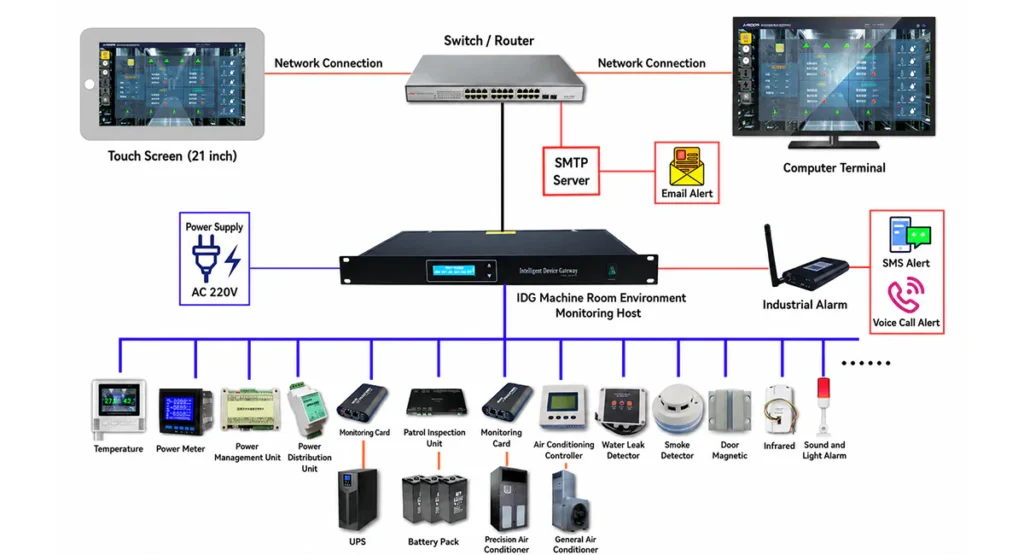
As the centralized nervous system of distributed AI infrastructure, the Instrava monitoring host is built on robust industrial communication frameworks to blend smoothly into existing corporate SCADA or ERP platforms:
-
Extensive Physical Interface Array: The monitoring gateway is equipped with
5*RS485,2*RS232,12DI(Digital Inputs),4DO(Digital Outputs), and dual Ethernet ports. -
Environmental Matrix Data: It continuously aggregates metrics from a dense matrix of water leakage detectors, smoke detectors, and precision temperature/humidity sensors to maintain an active digital twin of the micro-climate.
3. Specialized Human-Machine Interfaces (HMI) for Remote Sites
To offset the complete absence of on-site IT technicians at remote telecom branches or factory floors, Instrava optimizes local and remote visual interaction:
-
Visual Status RGB Lightstrips: The external chassis features dynamic, color-coded RGB light strips mapped directly to the environmental telemetry engine. Local personnel can instantly identify rack health (e.g., normal operation, power overload, or thermal alert) via intuitive color transitions without checking raw data monitors.
-
Dual-Layer Management Access: A local 10.1-inch Android touchscreen interface simplifies installation and commissioning, while a secure, comprehensive Web interface enables remote centralized engineering teams to perform predictive maintenance globally.
4. Enterprise Asset Protection: Power Resiliency and Physical Access Control
Edge AI inference nodes house highly valuable proprietary AI models and sensitive corporate data. The Instrava platform provides strict physical and electrical security perimeters:
-
Graceful Workload Migration: The system seamlessly integrates with $3\text{kVA} \text{ to } 15\text{kVA}$ high-reliability UPS modules. During unexpected utility grid failures, the UPS provides 5 to 10 minutes of full-load backup time. Concurrently, the monitoring host broadcasts a critical power alert to the AI servers, giving the OS sufficient time to save computation progress (Checkpoints), migrate running inference containers, or execute a graceful shutdown sequence.
-
Closed-Loop Access Auditing: Racks are secured by intelligent electronic locks supporting fingerprint authentication, PIN codes, RFID cards, and one-time remote administrative access tokens—with every entry event logged via immutable audit trails.
-
Non-Destructive Fire Suppression: The micro-enclosure supports optional clean-agent aerosol fire suppression modules designed to extinguish localized electrical fires instantly without depositing residue that could ruin high-cost GPU components.
Technical Specifications Matrix
| Component Cluster | Technical Specification Parameter | Edge AI Infrastructure Value Utility |
| Configurable Power Range | $2.4\text{kW}$ ถึง $12\text{kW}$ Max | Optimally scaled for 1 to 2 high-density AI inference units or multiple edge-compute arrays. |
| Precision Cooling Capacity | $3.5\text{kW}$ / $7\text{kW}$ / $12.5\text{kW}$ | Engineered for front-delivery/rear-return airflow topologies to suppress rapid GPU thermal spikes. |
| Energy Efficiency Index | Target System $\text{PUE} \le 1.3$ | Complies with strict global green energy mandates for decentralized edge computing nodes. |
| Emergency Mitigation | Automated Ventilation / Door-Pop (Opt.) | Mechanical fail-safe against cooling loss and thermal runaway events. |
| Host Connectivity Interfaces | 5*RS485, 2*RS232, 2*RJ45, 12DI, 4DO |
Comprehensive industrial protocol mapping to enable seamless enterprise SCADA/IT integration. |
| Fire Suppression Subsystem | Compressed Aerosol Fire Extinguisher (Opt.) | Zero-residue, non-conductive localized fire suppression protecting sensitive silicon logic boards. |
สรุป
As compute topology downshifts to localized Edge AI, the operational stability of decentralized micro infrastructures directly dictates the uptime of intelligent business applications. The Instrava IDC/AI Data Center Monitoring System condenses complex data center facilities engineering into an optimized, self-contained smart rack solution. By integrating efficient micro-climate containment, high-density industrial telemetry, and autonomous asset defense systems, it provides a highly reliable, turnkey digital foundation for enterprise AI at the edge.