The high continuous discharge current of an energy storage battery is typically measured by a high C-rate (such as $2\text{C}\text{–}5\text{C}+$). It refers to the battery’s ability to output a large, stable current over an extended period without triggering overheating protection or suffering a severe voltage sag. This characteristic falls under the battery’s C-rate Performance. The…

1. What Is an Field Emergency Backup Power Source? An emergency backup power supply is a power source prepared for unpredictable power demands in outdoor environments. It provides temporary or backup power in environments without reliable grid connections, experiencing temporary power outages, or where access to traditional power infrastructure is limited. As people increasingly rely…

Marine radios, trolling motors, auxiliary navigation equipment, pumping systems, engine starters, hydraulic systems, ventilation systems, and house load systems all require power. They are essential to your safety, vessel reliability, and cruising enjoyment. Marine systems demand a continuous power supply at all times, even when the engine or generator is turned off. So, how should…

Energy storage systems for RVs and campers are primarily categorized along two dimensions: battery chemistry and system integration format. 1.Classification by Battery Chemistry RV & Camping Energy Storage Comparison Parameter AGM Lead-Acid GEL Lead-Acid 51.2V LiFePO4 Drop-in Battery PPS Portable Power Station 400V High-Voltage Li-ion PACK System Voltage 12V / 24V 12V / 24V 51.2V…
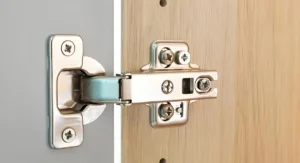
The opening angle of a concealed / cup hinge is determined jointly by the structural design of the hinge itself and the external installation environment, including the cabinet and door panel. These factors can be divided into two main levels: 1. Hinge Structural Design Different hinge models are generally designed with a specific maximum opening…
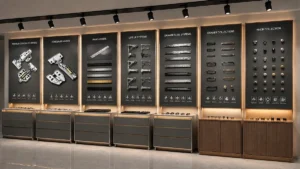
The global furniture manufacturing industry is at a critical juncture regarding the restructuring of production capacity and the diversification of supply chains. In many European countries, domestic furniture production is constrained by cost pressures, prompting an increasing number of small and medium-sized factories to source hardware components in bulk from China. Meanwhile, the panel furniture…
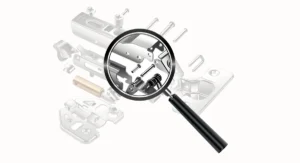
Numerous covert practices involving material substitution and cost-cutting have emerged in the production of cabinet hinges, all aimed at boosting profits. For suppliers, this is self-destructive behavior; for factories, it damages their reputation—the losses far outweigh the gains. 1. Six Common Material-Related Deceptions and Their Consequences 1.1 Passing off high-manganese 201 stainless steel as 304…
Three-dimensional micro-adjustment of cabinet hinges is used to align the position and gap of cabinet doors and panels in space. When using cabinet doors, issues such as misalignment, incomplete closing, or uneven gaps can be resolved by adjusting the hinges yourself. Modern cabinet hinges generally feature 3D adjustment functionality. Without specialized tools, using only a…
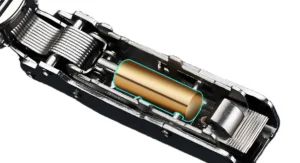
The Hydraulic Damping System of a hinge is primarily responsible for achieving the self-closing (Soft-Closing) effect, delivering “silent deceleration, impact prevention, and anti-pinch safety.” Core Principle: It utilizes the viscous resistance generated as hydraulic oil flows through micro-apertures in the piston within a sealed chamber to dissipate the closing kinetic energy of the door panel…
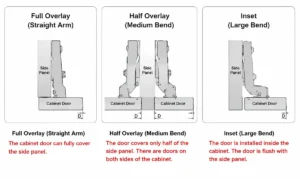
Hinges are categorized into Full Overlay (Straight Arm), Half Overlay (Crank/Bend Arm), and Inset (Large Bend Arm) to match different coverage relationships between the door panel and the side panel (Full Overlay / Half Overlay / Inset), ensuring accurate door closing positions and preventing operational interference. 1. What are Full Overlay, Half Overlay, and Inset…