
Magnetic Level Gauge vs Hydrostatic Level Gauge: Technology and Selection Guide
Introduction
Magnetic level gauges and hydrostatic level gauges are two widely used instruments for industrial liquid level monitoring. Both technologies are mature and reliable, but they serve different purposes and are suitable for different process conditions.
From an OEM manufacturer’s perspective, understanding the differences between a magnetic level gauge and a hydrostatic level gauge is essential for selecting the right level measurement solution. This article compares the two types in terms of working principle, performance, installation, and application suitability.
Working Principle
Magnetic Level Gauge
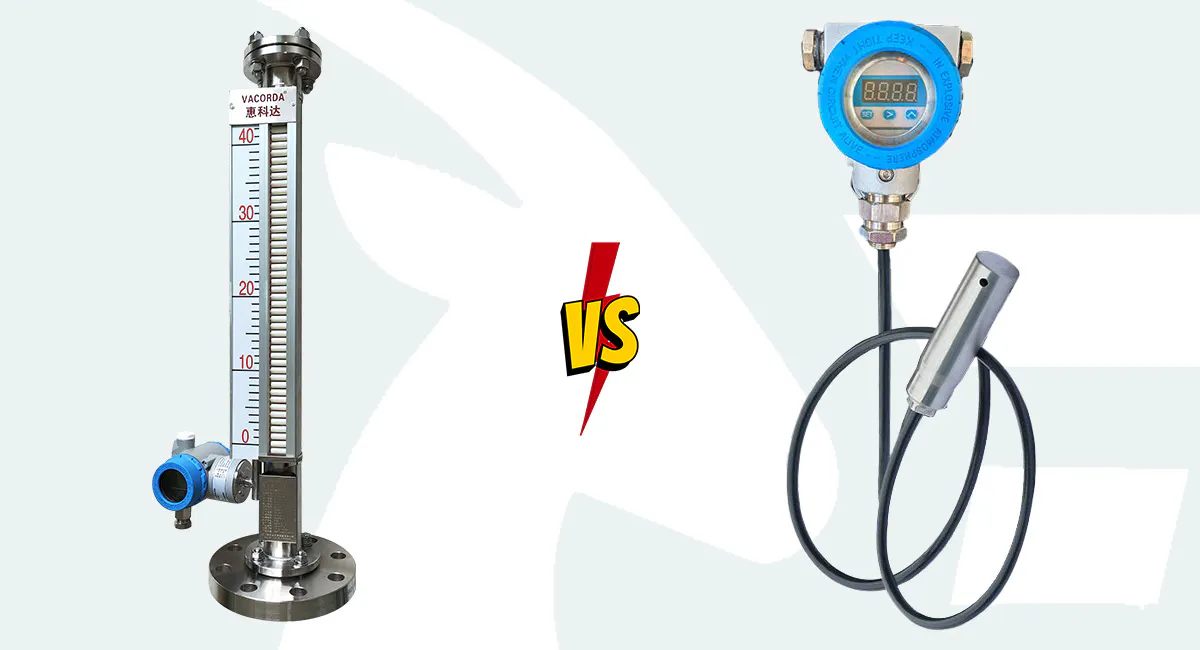
A magnetic level gauge is a visual contact-type instrument. It consists of a float containing a permanent magnet that moves up and down inside a sealed chamber as the liquid level changes. External indicator flaps or a magnetic display track the float position to show the real-time level.
Magnetic level gauges provide direct and intuitive level indication without requiring power supply or electronic signals.
Hydrostatic Level Gauge
Hydrostatic level gauges measure liquid level based on pressure. The device senses the hydrostatic pressure generated by the height of the liquid column and converts it into a standard output signal such as 4–20 mA.
This type of level gauge is an electronic measurement instrument and requires stable liquid density to ensure accurate readings.
Performance Comparison
| Item | Magnetic Level Gauge | Hydrostatic Level Gauge |
|---|---|---|
| Measurement Method | Direct visual indication | Pressure-based electronic |
| Power Supply | Not required | Required |
| Accuracy | High for local indication | High with stable density |
| Output Signal | Optional transmitter output | Standard electrical output |
| Maintenance | Low | Low |
| Density Influence | No | Yes |
| Temperature Tolerance | Good | Limited at high temperature |
| Pressure Suitability | Good | Limited |
| Failure Risk | Very low | Low |
Installation Comparison
| Installation Factor | Magnetic Level Gauge | Hydrostatic Level Gauge |
|---|---|---|
| Mounting Position | Side mounted on tank | Bottom or submerged |
| Process Connection | Requires external chamber | Threaded or flange |
| Medium Contact | Float in direct contact | Sensor in direct contact |
| Wiring | Not needed | Needed |
| Obstruction Influence | None | None |
| Maintenance Access | Easy side access | Bottom access needed |
Typical Applications
Magnetic Level Gauge Applications
Magnetic level gauges are ideal for:
High-temperature boilers
Pressurized vessels
Corrosive chemical tanks
Situations requiring local visual level display
Safety-critical processes without power availability
They are commonly used in petrochemical plants, storage tanks, and process vessels where operators need intuitive level monitoring.
Hydrostatic Level Gauge Applications
Hydrostatic level gauges are suitable for:
Atmospheric tanks
Water treatment systems
Underground reservoirs
Fuel and oil storage tanks
Remote monitoring via control systems
This technology is often selected when continuous electronic output is required.
Selection Guide from Manufacturer’s Perspective
When choosing between these two level gauges, manufacturers typically consider:
Whether visual local indication is required
Process temperature and pressure
Need for remote signal transmission
Liquid density stability
Installation space and budget
Magnetic level gauges are preferred for harsh environments and direct indication, while hydrostatic level gauges are chosen for economical remote monitoring projects.
Conclusion
Magnetic level gauges and hydrostatic level gauges each have unique advantages in industrial level measurement. The magnetic level gauge offers simple, safe, and highly reliable visual indication. The hydrostatic level gauge provides accurate and cost-effective electronic output for conventional applications.
By understanding their differences and consulting experienced OEM level gauge manufacturers, users can select the most suitable level measurement solution for their tanks and vessels.